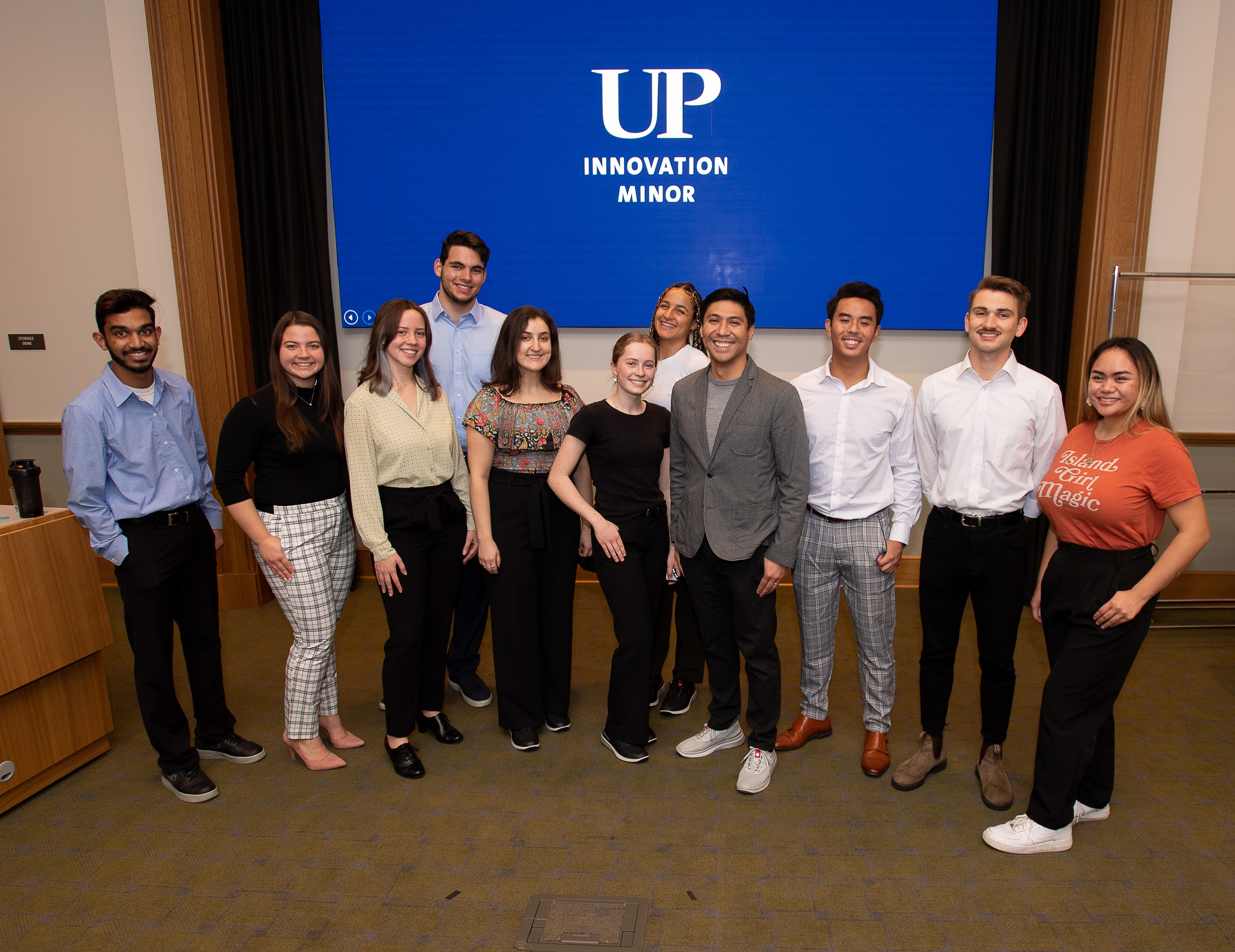
Overview
The Innovation Minor is a 15-credit, interdisciplinary academic program designed to address a structural failure in higher education: students are trained in disciplinary silos, while the problems they are expected to solve are inherently systemic, ethical, and cross-domain.
Engineering, nursing, business, and liberal arts students are rarely taught how to collaborate meaningfully—how to translate between forms of expertise, negotiate competing values, or make responsible decisions under uncertainty. As a result, innovation efforts often default to technical feasibility or market logic, leaving human, ethical, and institutional consequences unexamined.
The Innovation Minor was designed as an institutional intervention—a deliberately constructed system that assembles interdisciplinary cohorts and guides them through a sequence of sensemaking, materialization, and real-world engagement. At its core is the Industry-Sponsored Innovation Practicum, where these interdisciplinary dynamics are tested under real-world organizational constraints.
The Problem
Universities excel at producing specialists. They struggle to produce collaborators. Each discipline brings a distinct worldview:
+ Engineering prioritizes efficiency, optimization, and feasibility
+ Nursing centers care, safety, ethics, and lived human impact
+ Business emphasizes value creation, scale, and sustainability
+ Liberal Arts interrogate meaning, power, culture, and history
+ Nursing centers care, safety, ethics, and lived human impact
+ Business emphasizes value creation, scale, and sustainability
+ Liberal Arts interrogate meaning, power, culture, and history
In practice, these logics rarely meet. When they do, one tends to dominate—often technical or market perspectives—flattening complexity rather than engaging with it.
This is not a skills gap. It is a design problem: how institutions structure learning, authority, and collaboration.
The Intervention
The Innovation Minor reframes innovation as the synthesis of sensemaking and changemaking across disciplines. Rather than treating interdisciplinarity as a buzzword or elective outcome, the program is structurally interdisciplinary by design:
+ Cohorts intentionally mix students from engineering, nursing, business, and across liberal arts
+ Courses are sequenced to build shared language before shared action
+ Lived experience, disciplinary knowledge, and ethical reasoning are treated as equally legitimate forms of expertise
+ Courses are sequenced to build shared language before shared action
+ Lived experience, disciplinary knowledge, and ethical reasoning are treated as equally legitimate forms of expertise
The result is a learning environment where friction is not avoided—but designed for.
Program Architecture
The Innovation Minor operates as a four-layer system:
1. Orientation Layer
+ Introduction to Design & Innovation
+ Students confront dominant narratives of innovation and are introduced to futuring, systems thinking, and alternative definitions of value.
+ Students confront dominant narratives of innovation and are introduced to futuring, systems thinking, and alternative definitions of value.
2. Sensemaking Layer
+ Empathy & Human-Centered Design
+ Students learn ethnographic research, co-creation, and critical inquiry—developing the ability to understand complex human and institutional contexts.
+ Students learn ethnographic research, co-creation, and critical inquiry—developing the ability to understand complex human and institutional contexts.
3. Materialization Layer
+ Critical Making & Prototyping
+ Ideas become tangible through speculative artifacts, prototypes, and performative objects that surface ethical and systemic implications.
+ Ideas become tangible through speculative artifacts, prototypes, and performative objects that surface ethical and systemic implications.
4. Activation Layer (Capstone)
+ Industry Sponsored Innovation Practicum
+ Interdisciplinary teams engage real organizations, translating values into action under real constraints.
+ Interdisciplinary teams engage real organizations, translating values into action under real constraints.
This structure ensures that collaboration is learned, not assumed.
The Core Engine: Industry-Sponsored Innovation Practicum
The Industry Sponsored Innovation Practicum is the activation point of the entire system. Rather than functioning as a traditional client-based studio, the practicum is designed as a leadership and translation laboratory.
How It Works:
+ Interdisciplinary student teams (engineering, nursing, business, liberal arts)
+ 10-week engagement with an external organization
+ Faculty mentors aligned by domain and intent
+ Sponsors provide constraints—not answers
+ 10-week engagement with an external organization
+ Faculty mentors aligned by domain and intent
+ Sponsors provide constraints—not answers
What Makes It Different:
Students are not asked to “solve the problem.” They are asked to negotiate the problem and its intended beneficiaries.
This requires teams to:
+ Translate between disciplinary languages
+ Surface and reconcile conflicting definitions of success
+ Balance efficiency with care, scale with equity, and feasibility with responsibility
+ Make trade-offs visible rather than hiding them
+ Surface and reconcile conflicting definitions of success
+ Balance efficiency with care, scale with equity, and feasibility with responsibility
+ Make trade-offs visible rather than hiding them
In this context, innovation becomes a collective ethical act, not an individual performance.
Designed Role of Faculty & Program Leadership
Faculty do not function as content deliverers.
They operate as:
+ Interpreters between academic and organizational logics
+ Facilitators of interdisciplinary negotiation
+ Stewards of ethical and humane-centered inquiry
+ Facilitators of interdisciplinary negotiation
+ Stewards of ethical and humane-centered inquiry
Program leadership mediates:
+ sponsor expectations
+ student values
+ institutional constraints
+ student values
+ institutional constraints
This governance layer is critical. Without it, interdisciplinarity collapses into dominance by the loudest or most “legible” discipline.
Outcomes
For Students
+ Cross-disciplinary literacy
+ Ethical decision-making under ambiguity
+ Systems thinking and collaborative leadership
+ Confidence operating beyond their disciplinary comfort zone
+ Ethical decision-making under ambiguity
+ Systems thinking and collaborative leadership
+ Confidence operating beyond their disciplinary comfort zone
Students consistently describe a shift from seeking “the right answer” to holding multiple possibilities in tension.
For Partners
+ Reframed problem definitions
+ Exposure to non-market values and human consequences
+ Deeper insight into organizational blind spots
+ Exposure to non-market values and human consequences
+ Deeper insight into organizational blind spots
For the Institution
+ A replicable model for interdisciplinary learning
+ Stronger alignment between mission, pedagogy, and external engagement
+ Proof that innovation education can be rigorous, ethical, and humane-centered
+ Stronger alignment between mission, pedagogy, and external engagement
+ Proof that innovation education can be rigorous, ethical, and humane-centered
Why This Matters Now
As AI accelerates technical production and automation reshapes professional roles, disciplinary expertise alone is no longer sufficient.
The differentiator is the ability to:
+ collaborate across domains
+ reason ethically at scale
+ navigate uncertainty without defaulting to reductionist solutions
+ reason ethically at scale
+ navigate uncertainty without defaulting to reductionist solutions
The Innovation Minor anticipates this shift by treating interdisciplinary collaboration as a design challenge, not a soft skill.
Key Takeaway
The Innovation Minor is not a collection of courses.
It is a designed system for cultivating interdisciplinary innovators—individuals capable of translating between worlds, negotiating values, and acting responsibly within complex institutions.
At its center, the Industry Sponsored Innovation Practicum ensures that these capacities are not theoretical—but lived, tested, and consequential.